
Featured Story

When the Work Comes Back Around

Years ago, Project INSPIRE helped me understand and fight for meaningful math and STEM access for my blind daughter. Now Isabelle and I are carrying that story to Washington.

BlindnessBrailleSTEMFamily Advocacy

A federal grant decision can look remarkably small on paper.

Funded.

Not funded.

Five projects selected.

Others were not.

When I learned that Project INSPIRE NextGen: Promoting STEM Achievement and Academic Excellence for Students Who Read Braille was not among the projects selected for U.S. Department of Education funding, I did not see a line on a grant spreadsheet.

I saw Isabelle.

Isabelle is blind. She reads braille. For years I advocated for appropriate access to mathematics, STEM, braille instruction, tactile graphics, and the specialized instruction a blind student needs. One of the recurring problems was not simply knowing that something was wrong. It was being able to demonstrate, with authoritative professional resources, what appropriate instruction could actually look like.

That is where Project INSPIRE entered our family story—not as a logo on a webpage, but as work I could point to when Isabelle’s education needed math and STEM access that matched her potential.
“They gave me something extraordinarily valuable. They gave me evidence.”

— Rob Harris

What I Was Trying to Prove

I wasn’t looking for another resource. I was looking for evidence.

Project INSPIRE gave me that evidence—on Nemeth Code, braille math, tactile graphics, geometry, accessible STEM, instructional strategies, technology, and the expectations that belong with students who read braille.

I used their materials while challenging positions taken by educational team members. I am not saying Project INSPIRE won a legal case for us. I am not saying Penny Rosenblum or Tina Herzberg represented me. What they did was different, and in those moments it was exactly what I needed: field-level work I could bring to the table.

I could stop saying only, “My daughter needs this,” and start pointing to what the field itself said appropriate instruction could look like.

What Project INSPIRE Is

  • Began 2019 A five-year U.S. Department of Education, Office of Special Education and Rehabilitative Services project (H235E190003), as described on Paths to Literacy.
  • Purpose Increase the STEM potential of students who read braille.
  • Who it serves Professional development for TSVIs, paraprofessionals, braille transcribers, educators, and families.
  • Seven PD courses Free, self-paced courses on math braille codes, instructional practices, and materials.
  • Student programs Nemeth in a Box, Mission INSPIRE, Mathlete Competition, and WaterViz—among the student-facing work.
  • NextGen Project INSPIRE NextGen continues the work, currently supported by the Lavelle Fund for the Blind.

Project INSPIRE overview on Paths to Literacy

The Work Continues. The Question Still Matters.

Penny Rosenblum, Tina Herzberg, and their team recently learned that their Project INSPIRE NextGen proposal was not one of five projects selected for U.S. Department of Education funding. That is not the same as saying Project INSPIRE was “defunded,” shut down, or ended. The work continues.

The Lavelle Fund for the Blind is currently supporting Project INSPIRE NextGen. Paths to Literacy notes that support as of April 30, 2026. USC Upstate reports that this funding is allowing the team to update lessons in the seven professional-development courses (offered again in spring 2027 and fall 2027), continue Graphing in a Box programming into 2027, and hold a Mathlete Competition in spring 2027.

  • Lavelle Fund support noted as of April 30, 2026
  • Seven PD courses updating for spring and fall 2027
  • Graphing in a Box continuing into 2027
  • Mathlete Competition planned for spring 2027

USC Upstate on Lavelle Fund support for Project INSPIRE NextGen

Blind students do not stop needing accessible mathematics because a grant cycle ends. Braille readers do not stop needing quality STEM instruction because a proposal is not selected. Teachers do not automatically acquire specialized expertise in Nemeth Code, tactile graphics, and accessible STEM.

Someone has to build the knowledge. Someone has to teach it. Someone has to preserve it.

What happens on the other end of funding?

“How many people making these decisions ever get to see what happens on the other end of the funding?”

— Rob Harris

From specialized research to a student who can advocate—and a policymaker who hears what that access made possible:

  1. Research
  2. Professional development
  3. Teacher
  4. Parent
  5. Student
  6. Self-advocate
  7. Policymaker

In sequence: Research leads to professional development, which reaches a teacher, then a parent, then a student who grows into a self-advocate—until a policymaker can hear what that investment made possible.

Then Penny Wrote Back

Before we left for Washington, I contacted Penny Rosenblum and Tina Herzberg. I asked whether we could use Project INSPIRE as an example in our D.C. mission—as one concrete story of what specialized braille STEM investment makes possible for a student and a family.

They appreciated that Isabelle had benefited from the work. They provided a Project INSPIRE NextGen abstract. They offered to meet before the Hill week. They encouraged the D.C. effort.

“You’re going with a great team!”

— Penny Rosenblum and Tina Herzberg

The Work Came Back Around

Then

A parent carrying Project INSPIRE materials into educational meetings—looking for evidence that braille math and STEM access belonged in the room for his daughter.

Now

Isabelle is 19—a braille reader, an orientation and mobility traveler, and a self-advocate. At the end of September 2026, she and I go to Washington, D.C., with a team focused on blind, low vision, and deafblind education.

Next

The path from one family’s meeting table to national policy conversations is not abstract. It is a sequence of people doing their part—and asking systems to see what specialized investment actually does.

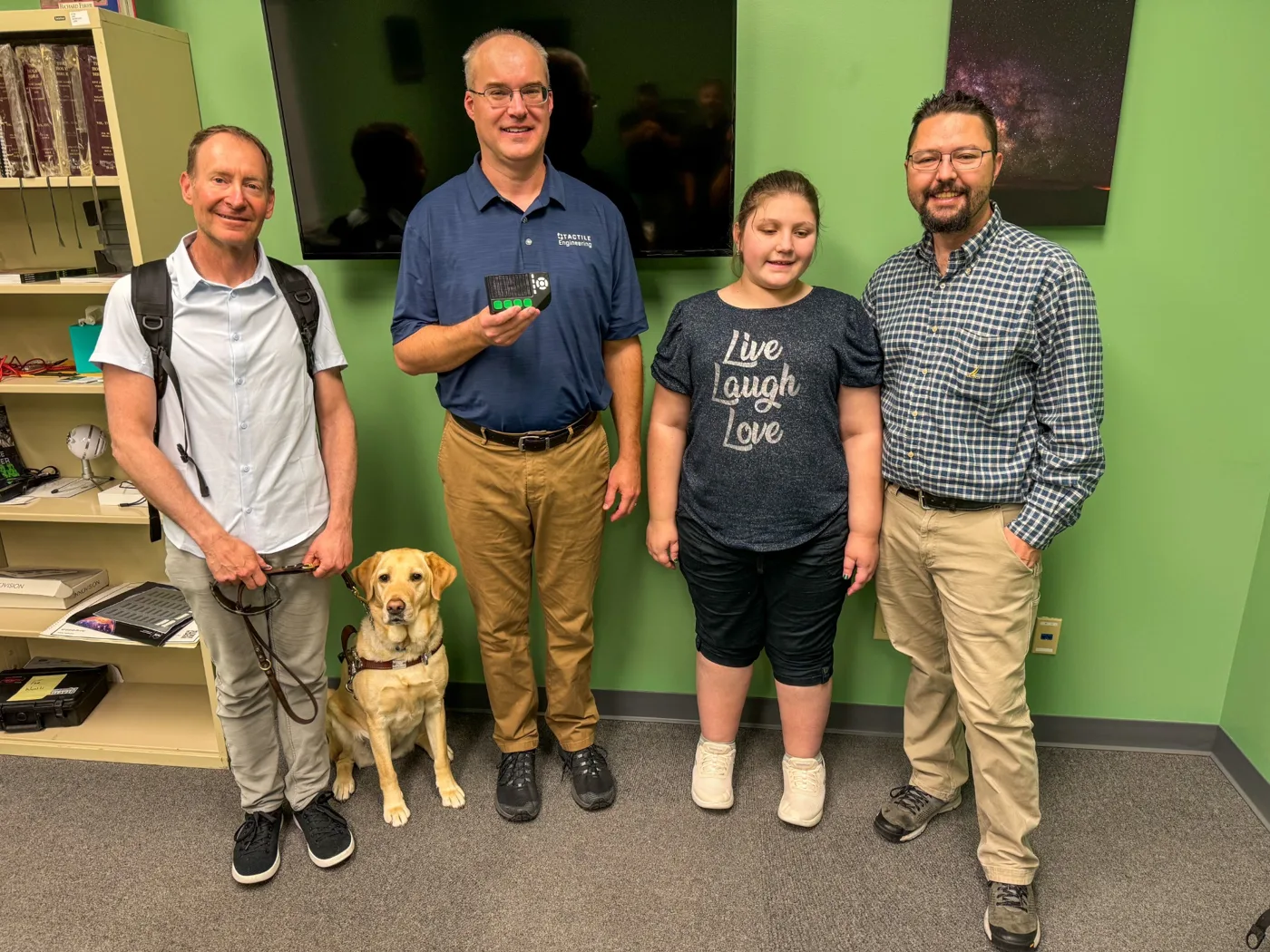
Rob Harris and Isabelle exploring a tactile engineering exhibit together.
Rob and Isabelle—the family story that specialized braille STEM work helped make possible.

“Years ago, I carried their work into educational meetings for my daughter. Now my daughter and I are carrying that story to Washington.”

— Rob Harris

Related: another path to this Washington week began with a conversation about parent experience—From a Conversation in Colorado to Washington.

How the Work Traveled

  1. 2019+

    Project INSPIRE builds resources for braille STEM—professional development, student programs, and materials educators and families can use.

  2. Family

    Rob finds the work and recognizes it as something he can bring into Isabelle’s educational meetings.

  3. Education

    The resources help him understand and fight for meaningful math and STEM access for his blind daughter.

  4. 2026

    Rob learns Project INSPIRE NextGen did not receive the federal award it sought.

  5. September 2026

    Rob and Isabelle prepare for Washington.

  6. Washington

    The story returns—carried by the parent who used the work and the daughter who lived it.

What we are asking people to see

A grant is never only a grant when a blind student gets STEM she can actually use. It becomes instruction. It becomes evidence. It becomes a young adult who can speak for herself—and a father who no longer has to argue alone that braille math belongs in the room.

That is the story. Not a slogan. A sequence: researchers and educators build the work; a parent carries it into a meeting; a student grows into a self-advocate; policymakers decide whether the next child gets the same chance.

The Work Behind the Story

Free materials from Project INSPIRE, hosted by Paths to Literacy. Open them. Share them. Use them with students and teams. AdvocateDadCO highlights them because of their impact on our family—we did not create or gate these resources.

  • Project INSPIRE • Paths to Literacy

    Project INSPIRE NextGen

    Overview of NextGen professional development and student programs continuing the work begun in 2019.

    Open resource
  • Project INSPIRE • Paths to Literacy

    Graphing in a Box

    A separate Project INSPIRE NextGen program helping 5th–8th grade braille readers build graphics skills through activities and games.

    Open resource
  • Project INSPIRE • Paths to Literacy

    Seven free PD courses

    Self-paced professional development for educators supporting PK–12 STEM learning for students who read braille.

    Open resource
  • Project INSPIRE • Paths to Literacy

    Student Programs

    Nemeth in a Box, Mission INSPIRE, Mathlete Competition, WaterViz, and related student-facing materials.

    Open resource
  • Project INSPIRE • Paths to Literacy

    STEM Resources

    Resource lists by grade band and content area, plus related webinars supporting braille STEM instruction.

    Open resource

This Story Is Going to Washington

Project INSPIRE is one example of what specialized blindness-education investment looks like when it actually reaches a family. Isabelle and I are carrying stories like this with us to Washington.